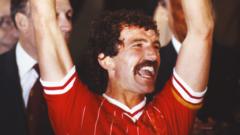
Graeme Souness has confirmed that he turned down a move to Barcelona after leaving Liverpool in 1984, a decision that surprised many given his status as one of the era’s top midfielders. The former Liverpool legend, who lifted the club’s fourth European Cup in 1984, chose instead to join Italian side Sampdoria for a fee of £650,000, a move that would prove pivotal for both his career and the club.
Souness explained that his departure from Anfield was driven largely by personal circumstances. “My wife was about to inherit money and she had to spend three years abroad,” he told BBC Scotland’s *The Saturday Show*. “I could have found a way around it, but I decided to go because Italy was where the best players were moving at that time.” He added that he had been offered a two‑year contract by Barcelona, which he declined because he wanted a longer deal and felt that a third year would be more suitable for his age. “There were a couple of other Italian clubs interested, but Sampdoria had just been bought by Paolo Mantovani, who was building a young squad and wanted an experienced player,” Souness said.
The move to Genoa paid off quickly. Souness helped Sampdoria secure an Italian Cup in his first two seasons before taking on the role of player‑manager at Rangers in 1986. His five‑year spell at Ibrox was marked by a trophy haul that transformed the club’s fortunes, and he has since served as an advisor on managerial appointments for the Rangers board. Despite his past success, the 73‑year‑old has stated that he would never return as Rangers manager, citing a mismatch between his “abrasive” style and the modern game’s demands. “My style of telling people what they don’t want to hear wouldn’t work today,” he said, contrasting himself with the more “nice” personality of Martin O’Neill, who has returned to Celtic.
Souness’s new book, *My Rangers: How I Changed Scottish Football Forever*, was released this week and includes reflections on the recent Old Firm clashes. He believes that Rangers’ recent 3‑0 League Cup win and 1‑0 Premiership victory over Celtic have given the club a psychological edge. “Celtic left Ibrox after the first game thinking, ‘how did that happen?’ and that didn’t flatter Rangers,” he noted. “Now, if a Celtic supporter sees the same result again, they’ll think ‘that won’t happen again,’ but it did.” He cautions that this advantage could be short‑lived if Rangers lose to a team they are expected to beat, and stresses the importance of Derek McInnes reminding his players that every match is a “cup final” for the opposition.
Souness’s career trajectory—from a European Cup‑winning midfielder at Liverpool to a transformative figure at Rangers—remains a testament to his impact on football across three continents. His decision to reject Barcelona in favour of Sampdoria and later Rangers shaped not only his own legacy but also the fortunes of the clubs he served.