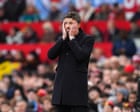
Manchester United’s fortunes have taken a dramatic turn since Michael Carrick stepped into the managerial role, leaving the club languishing in 16th place with no victories in their last eight outings across all competitions. The stark contrast between the 17‑match interim spell that saw United finish at the top of the Premier League last season and their current form underscores the severity of the situation. While a narrow defeat to Manchester City is a setback, the three‑goal losses to Como and Bournemouth signal a crisis that could prompt a managerial change.
Carrick’s tenure has seen United finish third in the league in terms of points, trailing only Arsenal (57) and Manchester City (56) with 46 points. However, this raw tally hides a deeper narrative. Opta’s expected points model indicates that United have earned 3.8 points fewer than their underlying statistics would suggest for the 2026‑27 season, placing them among only three clubs further adrift from their realistic standing. The club’s expected position of 10th is at odds with its high net transfer spend, which topped every club outside the Premier League bar Real Madrid, and its substantial annual revenue and storied history. Even when Carrick’s share of the 2025‑26 season shows an overperformance of 12.7 points, it was an anomaly that data analysts would predict to be unsustainable.
A key factor in United’s decline is the lack of decisive victories. Eight of the 12 league wins under Carrick last season were by a single goal, a figure surpassed only by Napoli in Europe’s top five leagues. In five of those eight wins, the expected goal margin was no more than 0.6 in United’s favour, and the team lost the xG by about 0.6 in draws against West Ham and Sunderland. The club’s reliance on narrow margins and the inability to convert possession into tangible results have been highlighted by their poor performance in high‑pressure matches. Despite dominating possession in several wins—such as the 32% in the Manchester derby and 38‑43% in victories over Liverpool, Chelsea, and Arsenal—United have drawn against Hull and Bournemouth while controlling 72% and 63% of the ball, respectively. Their struggle to break down teams even when dominating the ball echoes the challenges faced by former manager Ole Gunnar Solskjær.
Statistical analysis points to a decline in physical output as well. United’s average distance covered per match sits at 112.3km, the third‑lowest in the league, up only marginally from Carrick’s 102.2km in 2025‑26. More concerning is the drop in sprints per 90 minutes, a metric that has fallen below the levels seen under Carrick and even below the output of younger players like Casemiro. While the increase in possession—from 49.1% to 56.7%—may partially explain the reduced sprinting, the data suggests a broader issue. Manchester City leads the league in possession (64.7%) and still averages slightly fewer sprints than United, while Arsenal, with 61.1% possession, sprints more frequently. This pattern indicates that United’s decline in intensity is not solely a tactical choice.
Carrick has defended his approach, citing the need for movement in all directions to secure results. Yet the evidence points to a club that has lost the physical edge and the ability to convert possession into decisive outcomes. With the season’s most challenging fixtures still ahead, United’s outlook remains bleak unless significant changes are made both on the pitch and in the transfer market. The next few weeks will be critical as the club seeks to arrest the slide and restore competitiveness in the Premier League.