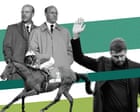
Manchester United’s decline has long been attributed to a succession of managerial missteps, but a closer look at the club’s history reveals that the roots of its woes stretch back to a single, seemingly innocuous event in the world of horse racing. The incident, which involved a horse named Rock of Gibraltar, set in motion a chain of ownership disputes and financial decisions that would eventually reshape the club’s fortunes and leave it mired in debt and mediocrity.
The story begins in 1999 when Irish businessman John Magnier, owner of the racehorse Mull of Kintyre, was denied the right to speak at the Gimcrack Dinner after his horse won the Gimcrack Stakes at York. Magnier, a man who disliked public speaking, had asked Sir Alex Ferguson to deliver the speech on his behalf, but the racing authorities insisted that only the owner could speak. In retaliation, Magnier named Ferguson as the owner of another horse, Juniper, which narrowly lost the following year. Undeterred, Magnier later made Ferguson the owner of Rock of Gibraltar, a horse that would go on to win its first three races and then dominate the Gimcrack Stakes in 2001. Magnier’s gesture was partly playful, but it also provided Ferguson with a taste of the racing world and a potential financial windfall.
Ferguson’s stake in Rock of Gibraltar was supposed to entitle him to 50 % of the horse’s prize money or stud fees, a deal that would later prove highly lucrative. However, Magnier’s recollection of the agreement differed, claiming only 5 % of prize money or a single stud nomination per year. The disagreement led Ferguson to file a lawsuit, which he likely would have won had it gone to trial. Instead, the dispute spiraled into a public scandal when Magnier and his associate JP McManus sent a list of 99 questions to United’s board, which somehow ended up in the Daily Mail. The controversy embarrassed the club and prompted protests from fans at race meetings. A settlement was reached, with Ferguson receiving £2.5 million to drop the action, but the damage to the club’s reputation was already done.
The fallout from the dispute also accelerated the sale of Magnier’s and McManus’s shares in Manchester United. In 2005, they sold their stakes to Malcolm Glazer for £260 million, a profit of nearly £100 million. The Glazers’ takeover would later be characterized by a leveraged buyout that saddled the club with crippling debt and led to a string of poor managerial appointments. Despite Ferguson’s success in winning five league titles and a Champions League during the early years of the Glazer era, the club’s fortunes deteriorated once his tenure ended, leaving it a mid‑table side plagued by financial instability.
Today, with Michael Carrick’s brief stint as manager ending in a 3‑0 defeat to Bournemouth and a 4‑1 loss to Como, United’s crisis appears to be a continuation of a 21‑year saga of mismanagement. The club’s current struggles are rooted not only in recent managerial failures but also in the legacy of ownership decisions that began with a single horse. As United look toward the future, the question remains whether the club can break free from the debt‑laden, decision‑driven culture that has defined its recent history.